The joke: “We’ll obviously all blame it on AI”
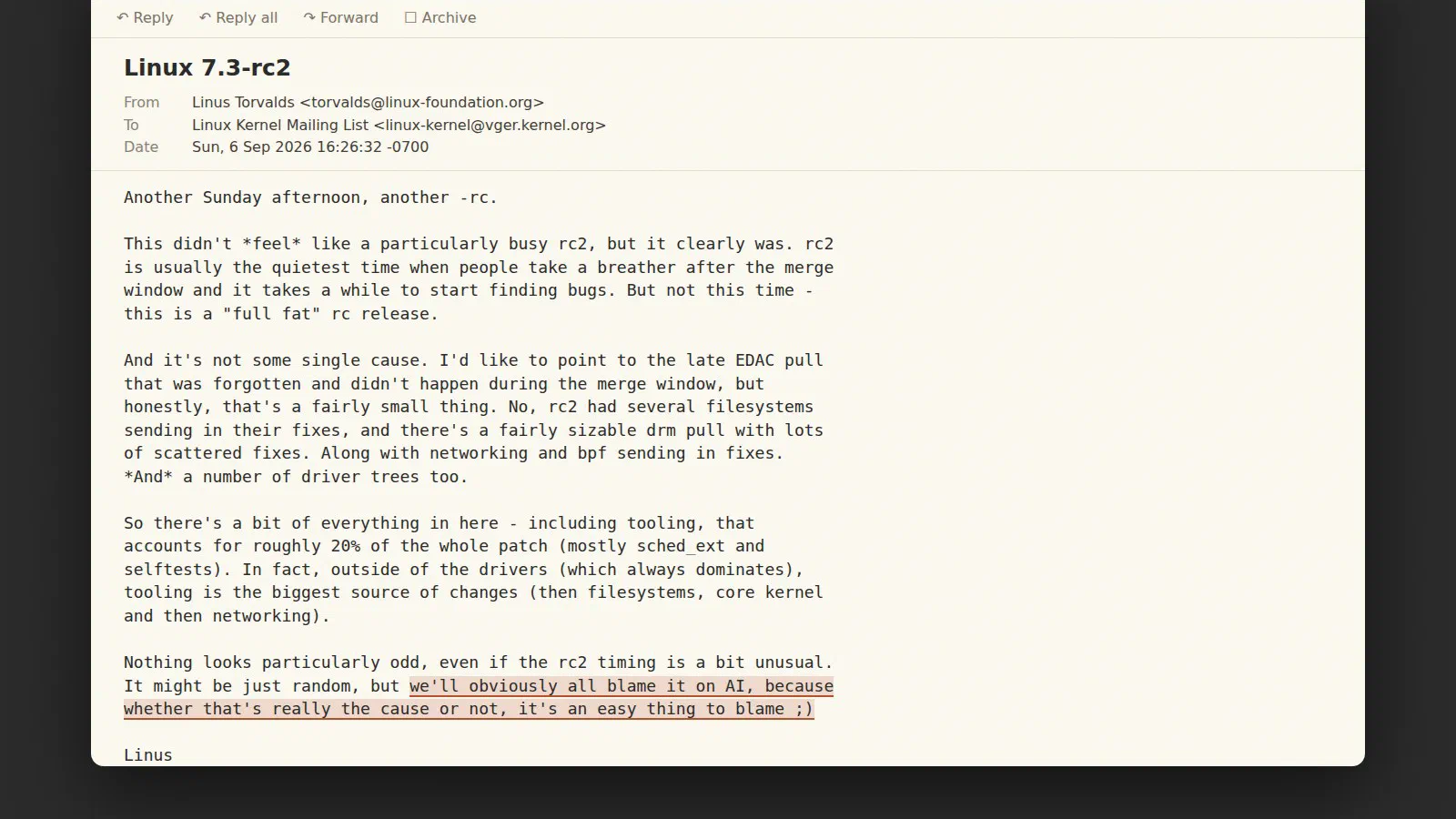
Linux 7.3-rc2 came out on Sunday 6 September, and Linus Torvalds ended the announcement with this: “It might be just random, but we’ll obviously all blame it on AI, because whether that’s really the cause or not, it’s an easy thing to blame ;)” [1]. That line made the headlines [2]. The rest of the email, where he lists what actually made the release big, got far less attention [3].
The size was real. “rc2 is usually the quietest time when people take a breather after the merge window and it takes a while to start finding bugs. But not this time - this is a “full fat” rc release.” [1] It was “not some single cause”, and “Nothing looks particularly odd” [1]. A week earlier he had called himself “a grade A nincompoop” for upgrading his machine in the middle of the merge window [2], so the AI line reads like a man who had already taken his share of the blame and was handing out the rest for fun.
What actually went into 7.3-rc2
The Next Web counted 615 commits from 292 contributors in the shortlog [3]. Counting non-merge commits between the v7.3-rc1 and v7.3-rc2 tags in Torvalds’ tree, I get 689. Either way it’s a lot for an rc2. According to Torvalds, tooling alone was about 20% of the patch, “mostly sched_ext and selftests”, and outside the drivers it was the biggest source of changes, ahead of filesystems, core kernel and networking [1]. A lot of that is test code.
Filesystem fixes
“rc2 had several filesystems sending in their fixes” [1]. OSTechNix went through them: hardening in NTFS, use-after-free fixes in the SMB client and the in-kernel SMB server ksmbd, and fixes in Btrfs and tmpfs [4]. It kept going: XFS in rc3, SMB and NTFS again in rc4, where Torvalds noted that “filesystems in general seem to have been getting more attention recently” [5].
The DRM (graphics) pull
Dave Airlie sent the graphics fixes on 4 September and summed them up as “rc2 fixes, lots of scattered fixes” [6]. Nouveau got a batch of display fixes for NVIDIA’s Blackwell GPUs “that should mean we light up monitors properly”, amdgpu had 24 fixes on its own, and there were changes to the core pagemap code [6]. The last item on his list was “the usual” batch of “AI inspired validation fixes” [6]. So AI did play a part in rc2, and the graphics maintainer said so in plain words, calling it usual.
Networking and BPF
Paolo Abeni’s networking pull on 3 September touched 86 files with 1,839 insertions and 703 deletions: regressions from earlier releases, plus bugs that had “always” been broken, like a TCP use-after-free and an SCTP soft lockup [7].
The BPF pull from Alexei Starovoitov arrived on 6 September, the same day as rc2. It had 89 commits across 58 files, and “mainly contains verifier fixes that address bugs reported by Nicholas Carlini” [8]. Most of those fixes were written by Eduard Zingerman [8]. One pull of 89 commits landing on release day will make any rc look fat.
Driver trees and a missed pull
“And a number of driver trees too.” [1] Drivers always make up the bulk of a kernel release, so that part is normal. Torvalds also mentioned a late EDAC (memory error reporting) pull that had been forgotten during the merge window, and then dismissed it himself as a small thing [1]. If he wanted a scapegoat, a forgotten pull request was right there. He picked AI because it was funnier.
The context: Torvalds on AI and kernel size in the 7.2 cycle
The joke had a serious version a month earlier. The weekly message for 7.2-rc6 opened with “This rc is huge.” [9] On 9 August, in the 7.2-rc7 announcement, he wrote: “I can’t say that I’m exactly thrilled about the size of this all, but it is what it is: the new normal with a lot of fixes, many of them due to review by various AI tools.” [10]
He has also said that “Linux is not one of those anti-AI projects”, and complained that the kernel security list has become almost unmanageable because of AI-generated bug reports, many of them duplicates [9]. And after rc2 he said it again, more precisely. In the rc4 announcement on 20 September: “There’s a lot of error path cleanup stuff, which various LLM’s seem to be pretty good at catching, but that typically isn’t going to be all that noticeable in normal use. But hey, if any of the issues hit you, you are going to care.” [5]
AI tools are one reason kernel releases are bigger now, and Torvalds knows it better than anyone. About rc2 he only said he couldn’t point to it as the cause of that particular week.
How the kernel tracks AI-assisted patches
The kernel has written rules for this. An AI agent “MUST NOT add
Signed-off-by tags”, because only a human can certify the Developer
Certificate of Origin, and the human who submits the patch is
responsible for reviewing the code and “Taking full responsibility for
the contribution” [11]. Contributions “should include an
Assisted-by tag”, in the format Assisted-by: LLM [TOOL1] [TOOL2],
where the tools are things like coccinelle or sparse, and ordinary tools
like git, gcc and editors aren’t listed [11].
The tag only shows what people chose to disclose. The Next Web points out that it’s voluntary in practice, and that a maintainer who cleans up a generated patch by hand doesn’t have to say so [3]. LWN counts the tags anyway. In the 7.2 merge window 706 of 13,412 commits had one, about 5% [12]. In the 7.3 merge window it was 1,264 of 15,267 commits, “just over 8% of the total, but is also surely a significant undercount of LLM-assisted commits in the kernel” [13].
The Next Web wrote that someone could count the tags in rc2, and that
“Nobody has.” [3] So I did. Of the 689 non-merge commits
between rc1 and rc2, 79 carry an Assisted-by line, about 11%. Between
rc2 and rc3 it was 137 of 653 (21%), and between rc3 and rc4 132 of 516
(26%). Most of the tags don’t follow the documented format either. Only
three in rc2 say Assisted-by: LLM; the rest name the tool and model,
like Claude:claude-opus-5 or Codex:gpt-5.6-sol.
AI-assisted commits were a minority of rc2. The share went up in the weeks after it, while the releases got a little smaller. That matches Torvalds’ rc4 comment about error paths better than the rc2 joke.
Why reflexive “AI did it” narratives are a problem
A joke on a mailing list is fine. The problem starts when the joke becomes the explanation, because then nobody reads the shortlog. The rc2 story was filesystems getting more attention, a large batch of BPF verifier fixes, a graphics pull full of scattered driver fixes, a growing pile of tests, and one forgotten pull request. None of that fits in a headline about AI.
“AI is flooding the kernel with junk” and “AI is fixing the kernel for us” both skip the same step: looking at which commits were tagged and what they changed. The Next Web makes a useful distinction between AI tools that review code and flag bugs, which is what Torvalds described in the 7.2 cycle, and AI that generates the code itself [3]. Those are different risks, and “AI did it” hides which one you’re talking about.
For people who run Linux, rc size also isn’t a quality measure. A big rc4 full of error path fixes means bugs that were already there are now being fixed. Whether 7.3 is safe to deploy depends on regressions, and you only find those by testing.
I use AI tools all the time, and they definitely have their merit. Maybe their biggest strength is being able to chew relentlessly through tons of data or lines of code, finding issues or misconfigurations.
At the same time, we need to use it responsibly. It’s a bit like back when we started talking about “the paperless society”: around the same time, printing became a lot more affordable, and paradoxically, for a society going paperless, we were printing more than ever. Recently, at a trade show, I talked to someone from a company most of us connect with printers and cameras, and he told me that it’s actually a few years ago now that the printing curve turned and started going down.
So while AI will most likely output more code, more text and more bug reports, it also has the capability to cut through all that signal. The only major issue I have with that is that we have now spent resources (hardware production and power) creating that extra-large pile of …, and now we may have to spend even more on processing, sorting and triaging it, and then on creating the PRs to fix things.
Let’s hope we actually get issues fixed without creating new ones in the process.
Giving credit to the maintainers
Whatever tool found a bug, a person still had to decide the fix was right and put their name on it [11]. For rc2 that was, among others, Dave Airlie collecting graphics fixes from amdgpu to virtio [6], Paolo Abeni for networking [7], Alexei Starovoitov and Eduard Zingerman for the BPF verifier [8], and the filesystem maintainers whose trees kept showing up through rc4 [5]. Airlie even pointed out the AI-inspired part of his pull himself [6], which is how disclosure is supposed to work.
If you want to check the next rc yourself, it takes one line in a clone of Torvalds’ tree:
git log --no-merges -i --grep='^Assisted-by:' --oneline v7.3-rc4..v7.3-rc5 | wc -lSources
- Linux 7.3-rc2 (LWN.net), pulled 2026-09-27
- Might as well blame AI for this giant Linux release candidate, says Linus Torvalds (The Register), pulled 2026-09-27
- Torvalds joked that AI made Linux 7.3-rc2 this big, and nobody checked (The Next Web), pulled 2026-09-27
- Linux Kernel 7.3 RC2 is Officially Released: Here’s What’s New (OSTechNix), pulled 2026-09-27
- Linux 7.3-rc4 (LWN.net), pulled 2026-09-27
- drm fixes for 7.3-rc2, pull request by Dave Airlie (dri-devel mailing list, via Ratatoskr), pulled 2026-09-27
- Networking for v7.3-rc2, pull request by Paolo Abeni (netdev mailing list, via Ratatoskr), pulled 2026-09-27
- BPF fixes for 7.3-rc2, pull request by Alexei Starovoitov (bpf mailing list, via Ratatoskr), pulled 2026-09-27
- Linus Torvalds says AI has made ‘huge’ Linux kernel updates the new normal (The Register), pulled 2026-09-27
- Linux 7.2-rc7 (LWN.net), pulled 2026-09-27
- AI Coding Assistants (Linux kernel documentation), pulled 2026-09-27
- The rest of the 7.2 merge window (LWN.net), pulled 2026-09-27
- The rest of the 7.3 merge window (LWN.net), pulled 2026-09-27