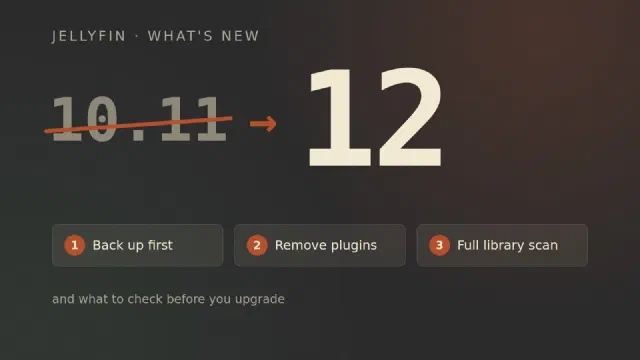
Jellyfin 12.0 came out on 7 September, and the first bugfix release,
12.1, followed a week later [1][3]. If you run
10.11 today, the next version is not 10.12 and not 11. It is 12. Here is
what is new, what breaks, and what to do before you press upgrade.
From 10.11 to 12
The number first, and a little history, because the obvious question is
why a project that began in 2018 was on version 10 at all. Jellyfin
started “in early December 2018 primarily as a result of Emby’s decision
to take their next release (4.x) closed-source”, as a fork of Emby 3.5.2
[6]. The new project wanted a clean break from Emby’s
version numbers, and chose to go up rather than down. The first Jellyfin
release, in January 2019, was 10.0.0, and the plan was “10.X.Y, with X
being major feature releases and Y being bugfixes” [7].
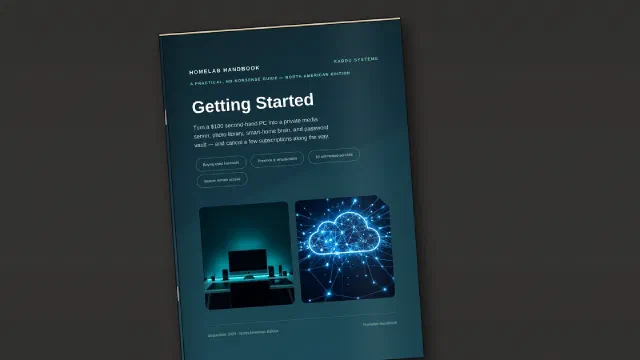
My first guide is out. Homelab Handbook: Getting Started is a
practical, no-nonsense handbook for turning an affordable used PC into
your first homelab, and it’s available now from the Kaddu Systems shop.
What it is and who it’s for
A homelab is simply a computer (or a few) that you run at home to host
services you’d otherwise pay someone else for, or hand your data to.
It can also be a playground where you can experiment and learn new skills, without affecting your production systems and important data.
I am preparing to start the 100 Days of Homelab challenge to educate myself into the different fields of computing that interests me and that will make a difference in my life, such as an improvement of quality of life, enhancing my career, generally sparking my imagination and creative side, and perhaps a mix of them all.
I am planning a reorganisation of my home network, the main goal is to restructure my network backbone and servers so that I can protect and run them in the best way possible. One of the things I would like to do is to setup my key network and my servers is to be supported by some kind of battery backup power system, with the possibility of boosting it with solar power so as to supplement prolong the time I can run them - a) during a power cut and b) with the current energy crisis and cost of energy in mind. Currently the only server I have running 24/7 is a Raspberry Pi that carries my Home Assistant and underneath that my Unifi controller.
It is time for taking stock of my servers. My setup has evolved a bit, but not as well planned as I would like it to have. I currently have 4 servers - 5 if you count my Linode/Akamai VPS but only one of them is actual dedicated server hardware.
Servers as of February 2024
Server number 1 is a Raspberry Pi 4B 2 GB running my Home Assistant and Unifi controller. This boots off a 2.5" 250 GB SSD connected via USB.